
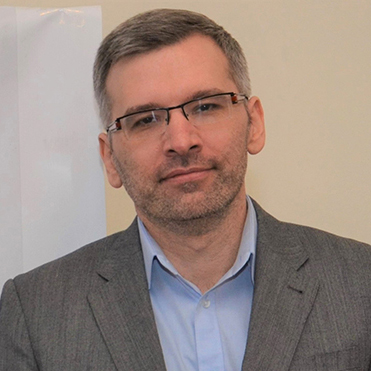
He holds a Ph.D. in Political Science and is an Associate Professor in the Department of International Relations and Diplomacy, Faculty of International Relations, Ivan Franko National University of Lviv.
European integration has been a central theme of his research and teaching, alongside a broader commitment to strengthening European Studies in Ukraine. Since 2018, he has been a Senior Research Fellow at the Jean Monnet Centre of Excellence, where his research focuses on “European Union Studies in Ukraine.” He has also coordinated or participated in a range of EU-focused academic and educational initiatives, including six additional Jean Monnet projects. Among them are the Jean Monnet Module EU’s Subnational Dimension, the Jean Monnet Network Linking to Europe at the Periphery, and the Jean Monnet Project Rebuilding the Potential of EU Studies in Conflict-affected Areas of Ukraine: Addressing Challenges and Creating Solutions.
He has also been active in international academic cooperation in the field of European Studies, through activities involving institutions including Central European University, the College of Europe in Natolin, Freie Universität Berlin, Middle East Technical University, the University of Bologna, the University of Tartu, the University of Turin, the University of Warsaw, Uppsala University, and Vytautas Magnus University, among others.
Courses Taught
· European Integration
· European Union External Relations
· EU’s Subnational Dimension
Research Interests
· EU Relations with Third Countries
· Regions and Cities in European Integration
· EU Enlargement
· European Studies
Selected Publications in European Studies
Books
· Regionalism in European Integration Processes. Kyiv: Znannya, 2007.
Book Chapters
“Cha(lle)nging Peripherality: ‘Critical Expectation Gaps’ and EU–Ukraine Relations in the Post-Euromaidan Perceptions of Ukrainian Political Elites” (with A. Tyushka). In M. Butnaru Troncotă, A. O. Özçelik, and R.-A. Cucută (eds.), Reconfiguring EU Peripheries: Political Elites, Contestation, and Geopolitical Shifts. Helsinki: Helsinki University Press, 2024.
“Resilient Academia: Fostering European Studies in Regions Impacted by Russian Aggression.” In Rebuilding the Potential of EU Studies in the Conflict-affected Areas of Ukraine: Addressing Challenges and Creating Solutions. Kyiv: APREI, 2023.
“European Union Enlargement – An Unfinished Business?” (with A. Semenovych). In D. Milczarek, A. Adamczyk, and K. Zajączkowski (eds.), Introduction to European Studies: A New Approach to Uniting Europe. Warsaw: Centre for Europe, University of Warsaw, 2013.
“The State of Research on European Integration in Ukraine.” In Poland in the European Union: Adjustment and Modernisation. Lessons for Ukraine. Warsaw: University of Warsaw, 2012.
Policy Papers
· European Studies in Ukraine: Unity in Diversity. Lviv: Ivan Franko National University of Lviv, 2023.
Articles
“European Studies in Ukraine: Major Trends and Patterns.” Eurolimes: Journal of the Institute for Euroregional Studies, vol. 30, 2021.
“EU–Norway Relations: A Model to Follow for Ukraine?” (with B. Barna). Ukrainian Yearbook of European Integration Studies, vol. III, 2019.
“Stronger Together? Ukrainian Cities and European Urban Networks.” Ukrainian Yearbook of European Integration Studies, vol. I, 2018.
“Cities and European Integration: Key Trends and Challenges.” Visnyk of Lviv University. Series International Relations, no. 46, 2017.
“Cities’ Engagement in the Eastern Partnership: Accomplishments and Challenges.” Politicus, no. 6, 2017.
“The Subnational Factor in EU Relations with Third Countries: The Canadian Experience.” Gileya, no. 126, 2017.
“The Impact of European Integration on Polish Voivodships.” Political and Sociological Studies, vol. IX, 2010.
“The European Dimension of Italian Regions’ Activities.” Visnyk of Lviv University. Series International Relations, no. 17, 2006.